Email sharing in Zoho Mail allows you to collaborate on emails without creating long chains of forwards and replies. Instead of sending copies of a message to colleagues, you can share the email conversation, invite relevant people to comment, and keep feedback connected to the original discussion.
This is particularly useful when teams need to review customer enquiries, discuss business decisions, coordinate responses, or get feedback before replying to an important email.
Zoho Mail provides several ways to collaborate, including automatic sharing of future messages, sharing selected emails from a conversation, general shareable links, and inviting colleagues to review drafts before sending them.
Email Sharing
Email Sharing lets you share an email conversation with colleagues and discuss its contents through comments. The original email remains the reference point for the discussion, reducing the confusion that can arise from repeated forwarding.
What can you do with Email Sharing?
-
Share email conversations: Invite relevant colleagues to view and discuss an email thread.
-
Collect feedback: Use comments to gather suggestions, opinions, or advice before responding to the original sender.
-
Mention colleagues: Use @mentions to bring specific users or Streams-enabled groups into the discussion.
-
Track collaboration: View who has access to a shared email and follow the related comments.
-
Share selected messages: Choose particular emails within a conversation when you do not need to share the entire thread.
-
Share through links: Generate a permalink to make an email accessible according to the permissions you configure.
-
Review drafts together: Invite colleagues to comment on an email before it is sent.
Email Sharing vs. Email Forwarding
| Feature | Email Sharing | Email Forwarding |
| Discussion | Feedback is added through comments connected to the shared email. | Replies can create separate email threads. |
| Original context | Keeps the shared email as the central reference point. | Context may become scattered across forwards and replies. |
| Collaboration | Supports comments and mentions among authorized participants. | Collaboration mainly happens through separate messages. |
| Sharing access | Participants access the shared email through Zoho Mail's sharing features. | The forwarded recipient receives a copy of the message. |
| Best use case | Internal reviews, team discussions, and feedback. | Sending email information to someone who needs a copy. |
Important: Sharing an email does not automatically notify the original sender or the other recipients. They are notified of the shared discussion only if they are included in it. People who receive a shared email also cannot automatically invite additional participants unless the sharing permissions allow it.
How Email Sharing works
Email Sharing replaces repeated forwarding with a shared discussion around the original email. You can share an email you have received or sent with relevant users in your organization.
How to share an email
-
Sign in to your Zoho Mail account.
-
Open the email you want to discuss.
-
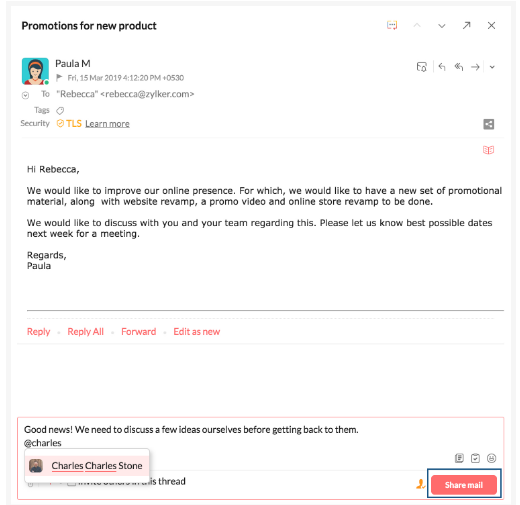
Open the email's comments or sharing option.
-
Mention the colleagues you want to involve using @mentions, or select the relevant users or Streams-enabled group.
-
Add a comment explaining what you need, such as feedback, approval, or a suggested response.
-
Click Share to notify the participants.
The invited users receive a notification and can open the shared email to review its contents and add comments.
What happens after you share an email?
| Action | Result |
| Share an email from a conversation | The entire conversation is shared with the selected users by default. |
| Share from Search results | The corresponding email conversation is shared, even when the search results display individual messages. |
| Add a comment | Participants can discuss the email in the shared discussion. |
| View all shares | You can check who is participating in the shared email discussion. |
| Invite another user | Additional participants can be added only when the relevant sharing permissions allow it. |
Advantages of Email Sharing:
-
Preserves the original message: Collaborators discuss the existing email instead of creating multiple copies that may become difficult to track.
-
Reduces inbox clutter: Fewer forwarding and reply-all messages are needed for internal discussions.
-
Keeps feedback contextual: Comments remain associated with the email being discussed, making it easier to understand why a suggestion was made.
-
Improves response preparation: Teams can review customer enquires or important business messages before sending a response.
-
Makes onboarding easier: Authorized participants can review the shared conversation and understand the discussion without reconstructing a long chain of forwarded messages.
-
Supports controlled collaboration: You can manage who is invited and whether participants are allowed to add other people.
For example, if a customer requests a change to a project deadline, you can share the email with the project manager and delivery team. They can discuss the implications in comments, allowing you to prepare a response without forwarding the same message repeatedly.
Enable email auto-share
When you share an email conversation, you can enable Auto-Share to automatically share future emails in that conversation with the existing participants. This is useful when the discussion is ongoing and new messages are expected.
Without Auto-Share, you may need to share subsequent messages separately. Enabling it helps collaborators remain informed as the conversation develops.
How to enable email auto-share
-
Sign in to Zoho Mail.
-
Open the email conversation you have already shared.
-
Open the comments section associated with the shared email.
-
Select the Auto-share future emails checkbox.
-
Continue using the conversation as usual. Future messages in that conversation will be shared automatically with the relevant participants.
When should you use Auto-Share?
| Scenario | Recommendation |
| An ongoing customer issue | Enable Auto-Share so the team can follow new replies. |
| A project requiring several rounds of discussion | Enable it to keep collaborators updated as the conversation progresses. |
| A one-time review of a completed email | Auto-Share may not be necessary. |
| A sensitive conversation with limited relevance | Review who has access before enabling automatic sharing. |
Practical tip: Auto-Share is most useful when the same group needs visibility into future replies. Before enabling it, confirm that everyone included in the shared conversation should be able to see subsequent messages.
Allow/Deny Invitees
Zoho Mail lets you control whether people who receive a shared email can invite additional participants into the discussion. This helps you balance collaboration with control over email access.
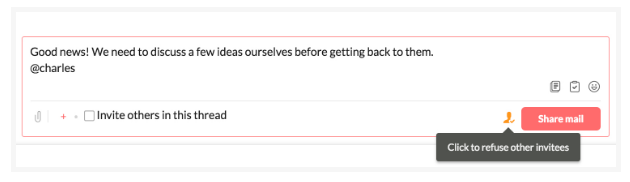
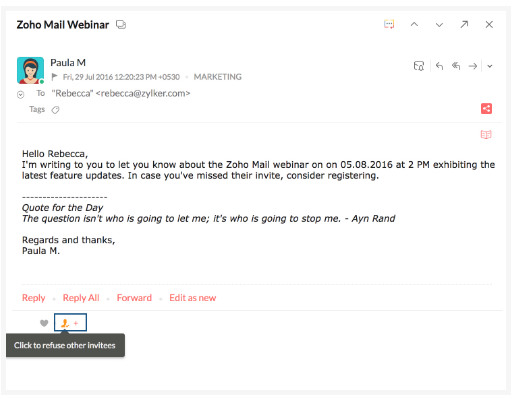
By default, invitees can generally add other participants. If you want to restrict this, use the option to disallow members from adding invitees when sharing the email.
How to allow or restrict invitees
-
When sharing an email: Select the option to disallow members from adding invitees before sharing, if you want only the original sharer to control access.
-
After sharing an email: You can change the invitee permission later using the corresponding sharing control in the email's discussion.
-
When allowing invitees: Participants with permission can add other relevant users to the shared discussion.
-
When restricting invitees: Other participants cannot invite additional people; the original sharer retains control over who can be added.
Permission options at a glance
| Setting | Effect | Best suited for |
| Allow members to add invitees | Participants can bring additional users into the shared discussion. | Routine team collaboration where the group may need to expand. |
| Disallow members from adding invitees | Only the person who shared the email can control additional invitations. | Sensitive customer matters, confidential discussions, or restricted project reviews. |
Important: Review the invitee setting before sharing sensitive business correspondence. Restricting invitations helps prevent uncontrolled expansion of the discussion, but you should also verify the access level whenever sharing an email.


Streams and Email Sharing
Zoho Mail Streams provides a collaborative space where teams can communicate through posts, comments, notes, tasks, and other shared activities. Email Sharing connects email conversations to this collaboration environment.
Instead of treating an email as an isolated message, team members can review it and discuss the next steps in a shared space.
How Email Sharing works with Streams
-
Receive notifications: Relevant users or group members are notified when an email is shared with them.
-
Open shared emails: Participants can access the shared email from the Streams interface.
-
Add comments: Team members can provide feedback or discuss the email's contents.
-
Collaborate with groups: Share emails with a relevant Streams-enabled group when several team members need to participate.
-
Review your shared posts: Emails you share with other groups or users can be accessed from My Posts under the Home tab.
Example: Using Streams for team collaboration
Imagine your sales team receives an important enquiry from a potential customer. The salesperson needs input from the technical and finance teams before replying.
-
The salesperson shares the email with the relevant colleagues.
-
The colleagues receive notifications and open the shared email.
-
The technical team comments on feasibility, while the finance team reviews pricing.
-
The salesperson uses the feedback to prepare an informed response.
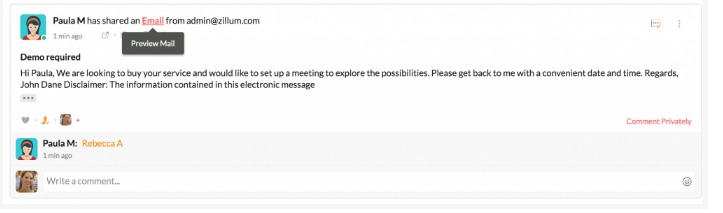
The emails shared by you with other groups or a set of users can be viewed from My Posts in the Home tab.
Selected Email Sharing
Sometimes, sharing an entire email conversation is unnecessary. A long thread may contain unrelated messages, confidential details, or earlier discussions that are not relevant to the person you want to involve.
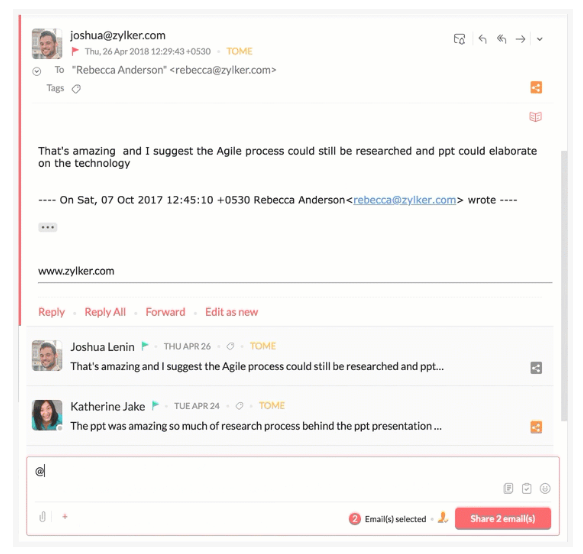
Selected Email Sharing lets you choose specific messages within a conversation and share only those emails with the relevant participants.
How to share selected emails:
-
Open the email conversation in Zoho Mail.
-
Locate the individual messages you want to share
-
Click the share icon next to each relevant email.
-
Select or deselect messages to include only the required emails.
-
Open the comment box and mention the colleagues you want to involve.
-
Add a comment explaining the context or feedback required.
-
Click share Emails.
Share mail as a link
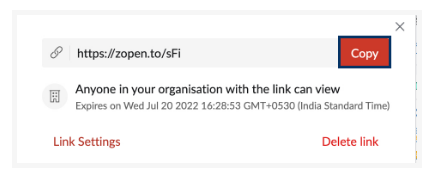
You can use a permalink to share emails (both sent and received). The content of an email or an email thread will be included in the created permalink. This link can be shared both within and outside your organization. The permalink can be accessed by your colleagues as well as anyone outside your organization, depending on the access level you choose.
Follow the steps given below to generate a permalink for an email:
Zoho Mail lets you generate a permalink for an email or email conversation. You can share this link with colleagues or, depending on the access level selected, people outside your organization.
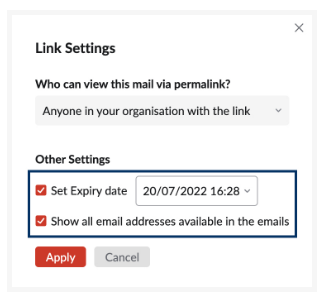
Unlike forwarding, a permalink gives recipients access to the email content through a link governed by the permissions you configure. You can also set an expiry date and choose whether email addresses in the message header should be displayed.
The permalink feature is available for the primary Zoho Mail account; it is not available for other accounts added through POP/IMAP or delegated email accounts.
How to create and share an email link
-
Sign in to Zoho Mail.
-
Open the folder containing the email you want to share.
-
Open the email or conversation.
-
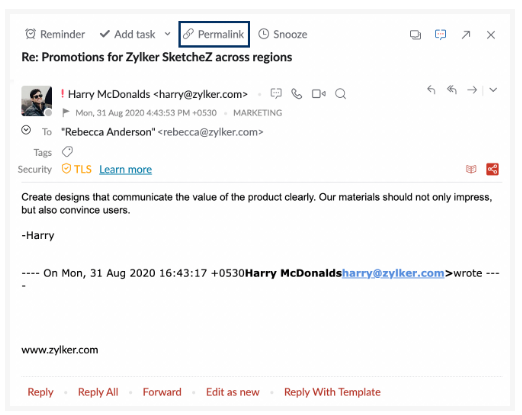
Click the Permalink icon. If you want to share an individual message within a conversation, use the permalink option in that message's header.
-
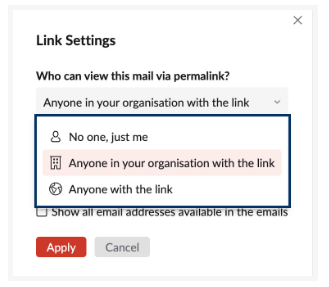
Open Link Permissions to configure access.
-
Choose the access level, set an expiry date if needed, and decide whether to display email addresses in the message header.
-
Generate the link and click Copy link.
-
Share the copied link with the intended recipients.
Email permalink access levels
| Access level | Who can view the email? | Recommended use |
| No one, just me | Only you, when signed in to your Zoho Mail account. | Keeping the link restricted to your own access. |
| Anyone in your organization with the link | Logged-in users within your organization who have the link. | Internal business communication. |
| Anyone with the link | Anyone who obtains the link, subject to the link's configured validity. | Sharing with external contacts when appropriate. |
Additional permalink settings
-
Expiry date: Set a date after which the link will no longer provide access to the email content.
-
Email address visibility: Choose whether the email addresses in the message header should be displayed.
-
Shortened URL: Where available, generate a shorter permalink for easier sharing.
-
Edit permissions: Change the link's access settings after creating it.
-
Delete link: Revoke access through the existing permalink. If you need to share the email again, generate a new link.
Security recommendation: Treat an “Anyone with the link” permalink as a shareable access credential. Send it only to intended recipients, choose an expiry date when appropriate, and avoid exposing confidential email addresses or correspondence unnecessarily.
Share Drafts
The Share Drafts feature lets you invite colleagues to review an email while it is still being written. Instead of sending a draft to someone for feedback and manually incorporating their suggestions, you can share the draft and discuss it through comments before sending the final message.
This is particularly useful for customer responses, formal announcements, proposals, sensitive communication, and messages that require managerial approval.
How to share an email draft
-
Compose a new email or open an existing draft.
-
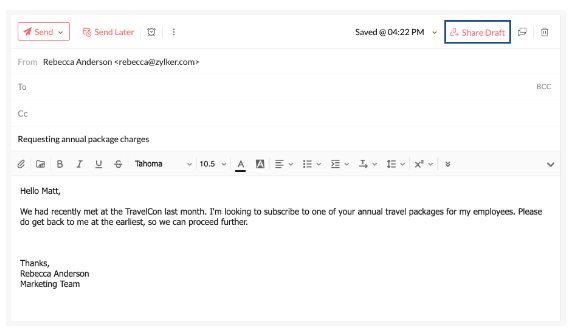
Click Share Draft in the composer.
-
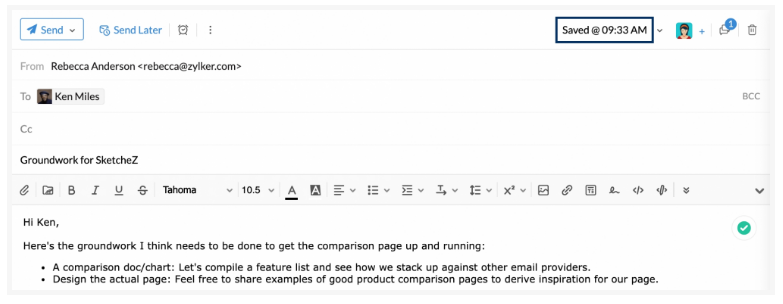
Zoho Mail automatically saves the draft when you initiate sharing.
-
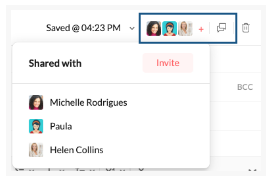
Select the users you want to invite from the list, or search for them using the search bar.
-
Click Share.
-
The invitees receive a notification and can open the shared draft to review it.
-
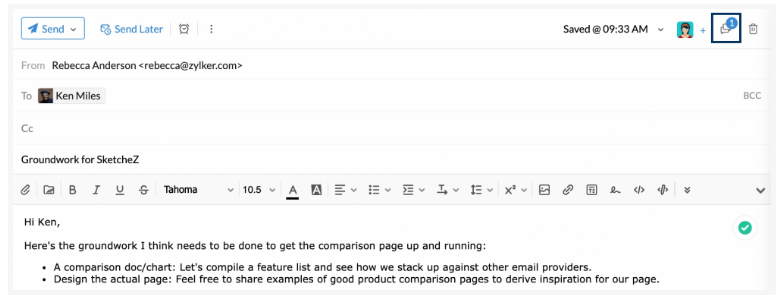
Use the comments section to discuss changes, clarify wording, and collect suggestions.